
Someone in your last leadership meeting probably said "we need to adopt AI" and everyone nodded while picturing completely different things.
Half the room was thinking about ChatGPT-style tools that draft emails and generate code. The other half was thinking about dashboards that predict next quarter's revenue.
Both sides were right and both were wrong, because they were talking about two fundamentally different technologies without realizing it.
According to McKinsey, 72% of organizations have adopted AI in at least one function as of 2024, yet most still struggle to connect AI investments to measurable business outcomes.
This article breaks down generative AI and predictive AI with real business use cases, a side-by-side comparison, and a clear framework for deciding which one your organization should prioritize first.
Teams looking to close the gap between understanding these concepts and actually implementing them can start with ProgNXT's AI training courses, which are built to move professionals from theory to production-ready skills.
What Is Generative AI and What Does It Actually Do?
The idea of machines generating content is not as new as it feels. Early experiments in the 1960s produced simple computer-generated poetry and music, and by the 1990s neural networks were already attempting to generate basic images and text.
But the real breakthrough came in 2017 when Google researchers published the "Attention Is All You Need" paper introducing the transformer architecture, which fundamentally changed what AI could produce. That single paper laid the groundwork for GPT, DALL-E, Stable Diffusion, and essentially every generative tool businesses rely on today.
Modern generative AI is built on large language models, diffusion models, and transformer architectures trained on massive datasets to learn patterns in language, images, code, and other content.
Once trained, these models generate entirely new outputs that follow those learned patterns. The key distinction is that generative AI creates something that did not exist before rather than selecting from existing options or predicting a numerical outcome.
When you ask ChatGPT to write a marketing email or use Midjourney to produce a product mockup, the output is new, assembled from learned patterns rather than pulled from a database.
Real Business Examples of Generative AI in 2026
The use cases have moved well past novelty and into daily operations across most industries:
Content production at scale including marketing copy, product descriptions, and full email campaigns that used to take days to draft
Code generation and developer assistants like GitHub Copilot, Cursor, and Claude for code that accelerate shipping timelines
Customer-facing chatbots and virtual agents that hold natural multi-turn conversations without sounding robotic
Image and video generation for creative teams producing product mockups, ad variations, and social content without a full design cycle
Document summarization and knowledge extraction across legal, finance, and operations where teams need to process thousands of pages fast
What Generative AI Is Not Good At
It cannot make reliable numerical predictions or forecasts. It carries hallucination risk, meaning outputs can sound confident while being factually wrong.
And it should never replace human judgment in high-stakes decisions without a review layer sitting between the model and the final call.
What Is Predictive AI and How Does It Drive Business Decisions?
Predictive AI has deeper roots than most people realize. The foundational concepts trace back to the 1950s and 1960s when statisticians began using regression analysis and Bayesian probability to model outcomes from historical data, and the field evolved through decades of actuarial science, econometrics, and operations research long before "artificial intelligence" became a boardroom buzzword.
Machine learning algorithms in the 1990s and the big data explosion of the 2010s gave these models the power and fuel to deliver business-critical accuracy at scale.
Today predictive AI is built on statistical models, classification, time-series analysis, and modern ML algorithms trained on historical data to surface patterns humans would miss.
Once established, the model applies those patterns to new data and forecasts what is likely to happen next. The key distinction from generative AI is simple: predictive AI tells you what will probably happen, not what to create.
Real Business Examples of Predictive AI in 2026
These are not experimental use cases anymore, they are embedded in how companies operate at scale:
Demand forecasting for supply chain and inventory management that prevents both overstocking and stockouts
Customer churn prediction and retention modeling that lets teams intervene before a high-value account walks away
Fraud detection across banking, insurance, and e-commerce where millisecond-level scoring catches threats human reviewers would miss
Predictive maintenance in manufacturing and logistics that schedules repairs before equipment fails and production stops
Lead scoring and sales pipeline forecasting in B2B that helps reps focus on deals most likely to close
Recommendation engines powering Netflix, Spotify, Amazon, and similar platforms where personalization drives engagement and revenue
What Predictive AI Is Not Good At
It cannot generate creative or unstructured content. It struggles badly when historical data does not exist or is unreliable, because the entire model depends on learning from the past.
And it cannot adapt quickly to entirely new scenarios without retraining, which means sudden market shifts or black swan events often break predictions before teams can react.
How Do Generative and Predictive AI Compare Side by Side?
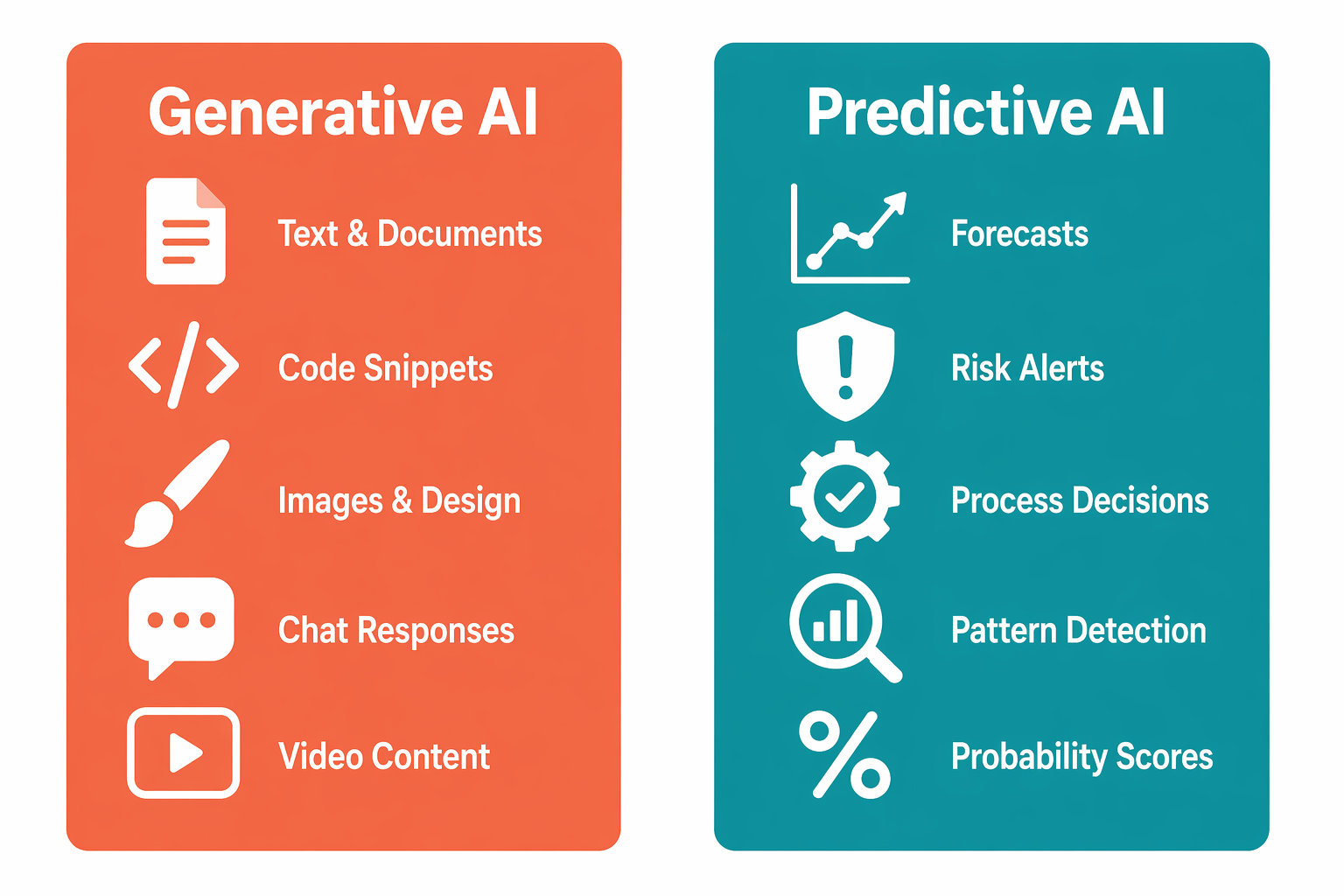
The table below cuts through the noise and puts both AI types next to each other across the dimensions that actually influence purchasing, hiring, and implementation decisions.
This is not an exhaustive technical breakdown but rather the comparison framework your team needs when evaluating vendors, scoping projects, or deciding where to invest first.
Where Most Businesses Get Confused
Three mistakes come up over and over again when organizations start evaluating AI.
The first is assuming generative AI can replace predictive analytics. It cannot reliably forecast numbers, and asking a large language model to predict next quarter's revenue is like asking a novelist to do your accounting. The words might sound convincing but the math will not hold up.
The second is assuming predictive AI can produce creative outputs. A churn model can tell you which customers are likely to leave but it cannot write the re-engagement email that brings them back. These are fundamentally different capabilities and one does not substitute for the other.
The third and most common is treating "AI" as a single category when evaluating vendors or tools. A platform that excels at generative tasks may offer predictive features as an afterthought, and vice versa. Lumping everything under one budget line or one vendor decision leads to underperformance on both fronts.
This confusion is exactly why teams need structured training before investing in AI tools. ProgNXT's AI courses are designed to help business and technical teams understand which AI approach fits which problem, so adoption starts with clarity instead of hype.
Where Do Generative and Predictive AI Overlap or Work Together?
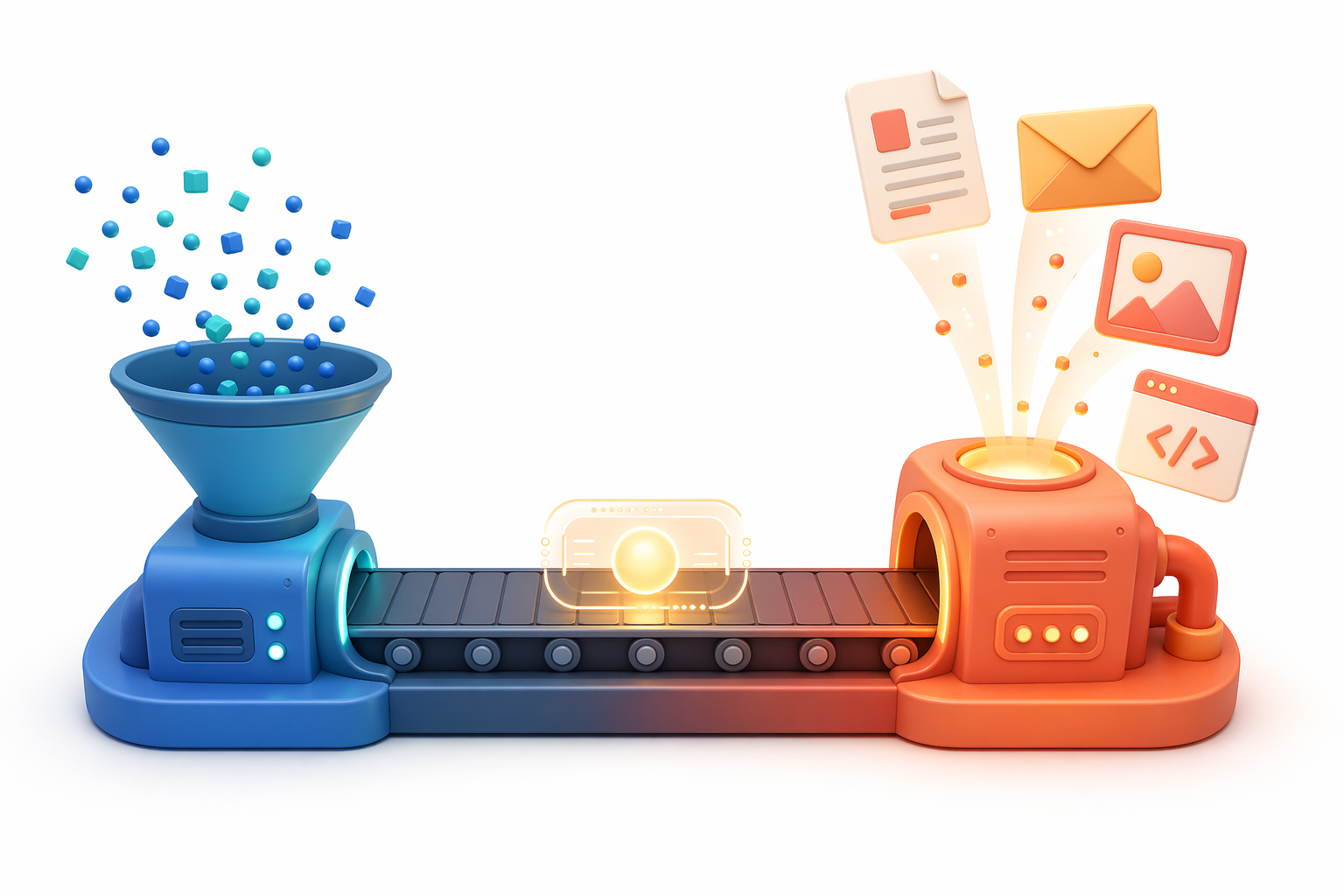
The most powerful AI implementations in 2026 are not choosing one type over the other, they are chaining both together in a single workflow:
Predictive models identify the signal, for example flagging that a specific customer is likely to churn within 30 days
Generative AI acts on that signal by drafting a personalized retention email tailored to that customer's usage history and preferences
A real example already playing out in e-commerce: predictive AI forecasts which products will trend next quarter, then generative AI produces the marketing copy and product descriptions for those items before demand even peaks
Emerging Hybrid Workflows in 2026
The line between these two AI types is blurring fast as teams build pipelines that handle prediction and generation in a single pass:
AI agents that combine forecasting and content creation without human handoff between steps
Retrieval-augmented generation (RAG) systems that pull from predictive data stores before generating responses, grounding outputs in real business data instead of general training knowledge
Sales teams pairing predictive lead scoring with generative email drafting so reps spend time closing instead of writing
Why "Both" Is Often the Right Answer
Most mature AI strategies already deploy both types across different functions. The marketing team runs generative tools while the finance team runs predictive models and neither needs to wait for the other. The real question is not "which one" but "which one first" and "where do we start."
Building hybrid AI workflows requires teams that understand both sides. ProgNXT's training programs cover generative and predictive AI together, helping teams design end-to-end solutions rather than adopting tools in isolation.
How Should a Business Decide Which AI to Invest in First?
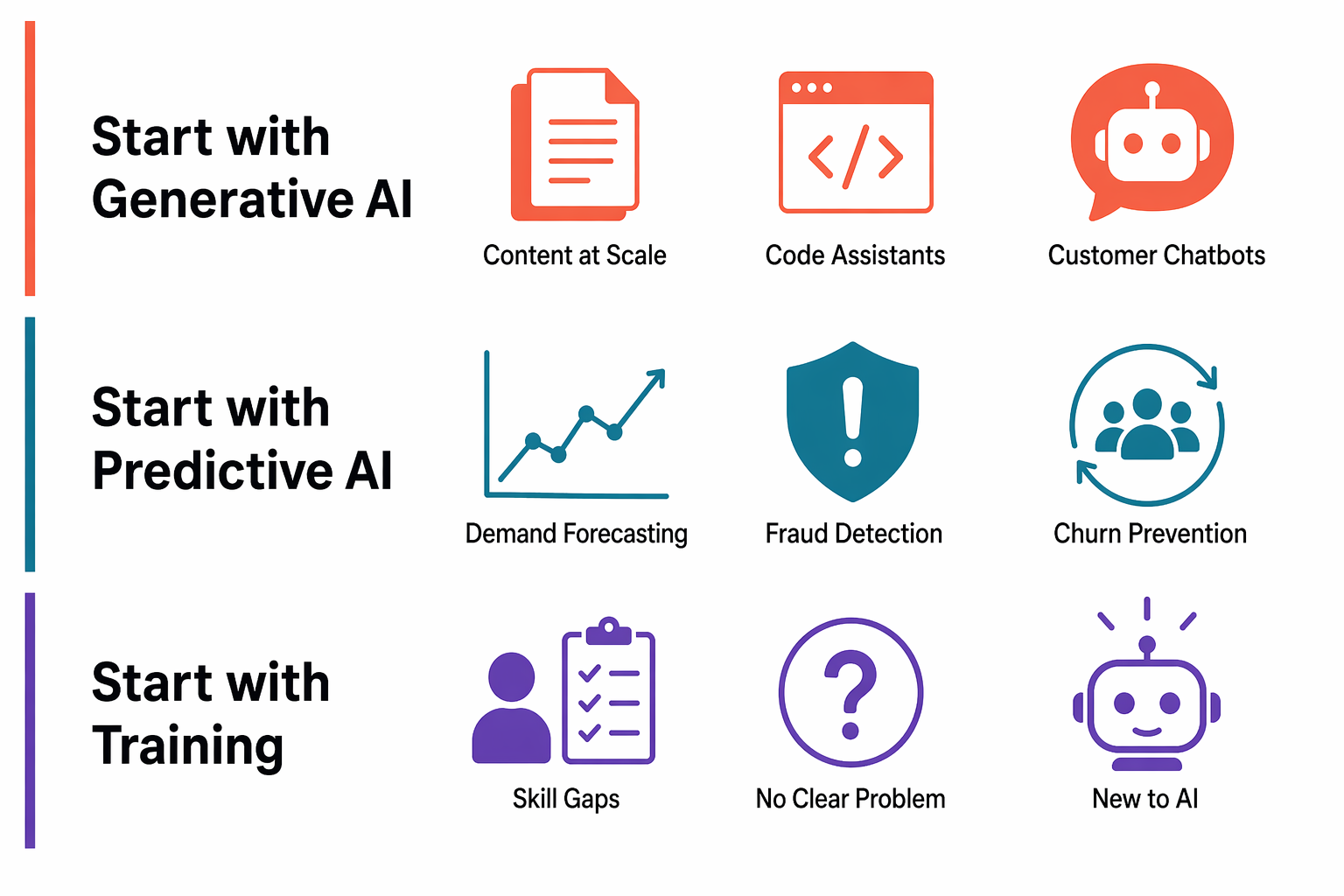
The answer almost never starts with the technology. It starts with three questions your team should be able to answer clearly before any vendor call gets scheduled or any budget gets approved.
Start with the Business Problem, Not the Technology
If your core problem is "we need to create more content, code, and communications faster," generative AI is your starting point.
If the problem is "we need to make better forecasts, reduce risk, or optimize operations," predictive AI gets you there.
And if the honest answer is "we are not entirely sure what our problem is," then the right first investment is training, not tooling.
Buying a platform before you can articulate the problem it solves is how organizations end up with expensive shelfware and a team that does not trust AI to deliver.
Assess Your Data Readiness
Predictive AI requires clean, structured historical data and if your data infrastructure is weak the models will underperform no matter how good the algorithm is.
Data readiness remains the number one blocker for predictive AI adoption in most organizations.
Generative AI can deliver value faster because pre-trained models like Claude or GPT work out of the box for many use cases without needing months of data pipeline work first.
That does not make generative AI better, it just means the time-to-value curve looks very different and your team should factor that into the sequencing decision.
Address the Skill Gap Before You Buy Tools
Most failed AI projects fail because of people, not technology. Teams need practical understanding of prompt engineering, model evaluation, data pipelines, and responsible AI practices before they can get real value from any platform.
Hiring alone does not solve this either, because the talent market is tight and onboarding external hires still takes months.
Upskilling existing teams is faster, more sustainable, and builds institutional knowledge that stays when contractors leave.
This is where the gap between AI ambition and AI execution shows up. ProgNXT helps organizations close that gap with role-specific AI training for developers, data teams, and business leaders, so your team can evaluate, implement, and maintain AI systems with confidence instead of guesswork.
Conclusion
Generative AI creates. Predictive AI forecasts. Both are valuable and the strongest AI strategies use them together.
The deciding factor for most businesses is not the technology itself but whether their teams have the skills to implement it properly.
Tools without training produce hype. Training without tools produces nothing. The combination produces results.
Build an AI-ready team that knows the difference and can execute on both. Explore ProgNXT's AI training programs and turn your team's AI curiosity into measurable capability.