
SLM over LLM: Why Small Language Models are the Secret to Efficient, Private AI Agents

A team at a mid-size fintech company deployed GPT-4 for internal document classification last year. The results were good. The $15,000 monthly inference bill was not.
When an ML engineer on the team fine-tuned a 3B parameter model on the same dataset and ran it on a single GPU, it hit 95% accuracy for under $500/month. Same task, same quality threshold, thirty times cheaper.
That story is playing out across thousands of organizations right now, and it exposes a bias most engineering teams still carry: the assumption that bigger models always mean better results.
Gartner projects that more than 50% of enterprise AI deployments will use smaller, task-specific models by 2027, up from just 1% in 2023. The era of defaulting to the largest available model for every use case is ending fast.
This article breaks down what SLMs actually are, where they outperform LLMs on cost and privacy and latency, real use cases where smaller models win, where LLMs still hold the edge, and how to build the skills to deploy the right model for each task.
Teams ready to move beyond the "GPT-4 for everything" default can start withProgNXT's AI training programs, which cover model selection, fine-tuning, and deployment from the ground up.
What Are Small Language Models and How Did We Get Here?

Small language models typically sit between 500 million and 13 billion parameters, though that boundary keeps shifting as efficiency techniques improve.
They use the same transformer architecture as their larger counterparts but are trained on curated or domain-specific datasets rather than ingesting the entire internet.
The goal is precision on a narrower set of tasks rather than broad general capability.
The SLM landscape in 2026 has real depth:
Microsoft Phi-4 pushed the boundaries of what sub-14B models can achieve on reasoning benchmarks
Google Gemma 2 optimized for on-device deployment and fine-tuning accessibility
Mistral 7B became the go-to open-weight model for teams wanting strong performance with minimal hardware
Meta LLaMA 3.2 (1B and 3B variants) opened up edge deployment for mobile and IoT use cases
Apple OpenELM brought efficient on-device inference into the Apple ecosystem
The Shift from "Bigger Is Better" to Right-Sizing
From 2020 to 2023, the entire AI industry was chasing scale. GPT-3 led the way, GPT-4 and PaLM followed, and the logic was simple: more parameters equals better results.
Then by 2024 teams started noticing something. A fine-tuned 3B model could handle classification just as well as a 175B model, at a fraction of the cost, on hardware you could fit under a desk.
Microsoft, Google, and Meta all published research backing this up, and the momentum shifted.
Inference bills, latency constraints, and privacy regulations made it harder to justify running massive models for tasks that never needed that firepower.
The same thing has played out in every tech cycle before this one. Databases, cloud infrastructure, mobile apps.
The first wave always chases maximum power and the second wave figures out the right tool for the job.
Why Are SLMs Better for Privacy and Data Compliance?
SLMs can run on a single GPU, a laptop, or an edge device. That means sensitive data never has to leave your network.
When you make an API call to GPT-4 or Claude, your data travels to a third-party cloud, gets processed on infrastructure you do not control, and depending on the provider's terms may be logged, cached, or folded into future model training.
For a marketing team drafting blog posts that is probably fine. For a hospital processing patient notes, it is a problem.
Here is a real scenario. A healthcare organization needs to summarize thousands of patient notes weekly.
Running a fine-tuned SLM on internal servers keeps all Protected Health Information (PHI) inside the hospital network.
Sending those same notes to an LLM API opens a HIPAA compliance question that legal teams will spend months reviewing before a single note gets processed.
Same task, same output quality, completely different risk profile depending on where the model runs.
Compliance Frameworks That Push Toward SLMs
Once you start mapping regulatory requirements to model deployment architecture, the pattern becomes clear:
GDPR requires data residency and processing controls that make local inference the path of least resistance for EU organizations
HIPAA restricts how healthcare data gets processed and stored, which strongly favors on-premise or on-device inference
SOC 2 audit requirements around data handling become significantly simpler when data stays within controlled infrastructure
Financial services regulations increasingly demand explainability and data control that cloud-based LLM APIs struggle to guarantee at the contract level
Most engineering teams treat model selection and compliance as separate conversations, which is exactly where the gaps show up in production.
ProgNXT's AI training teaches both together so teams make deployment decisions that satisfy engineering requirements and legal requirements at the same time.
How Do SLMs and LLMs Compare on Cost, Speed, and Hardware?
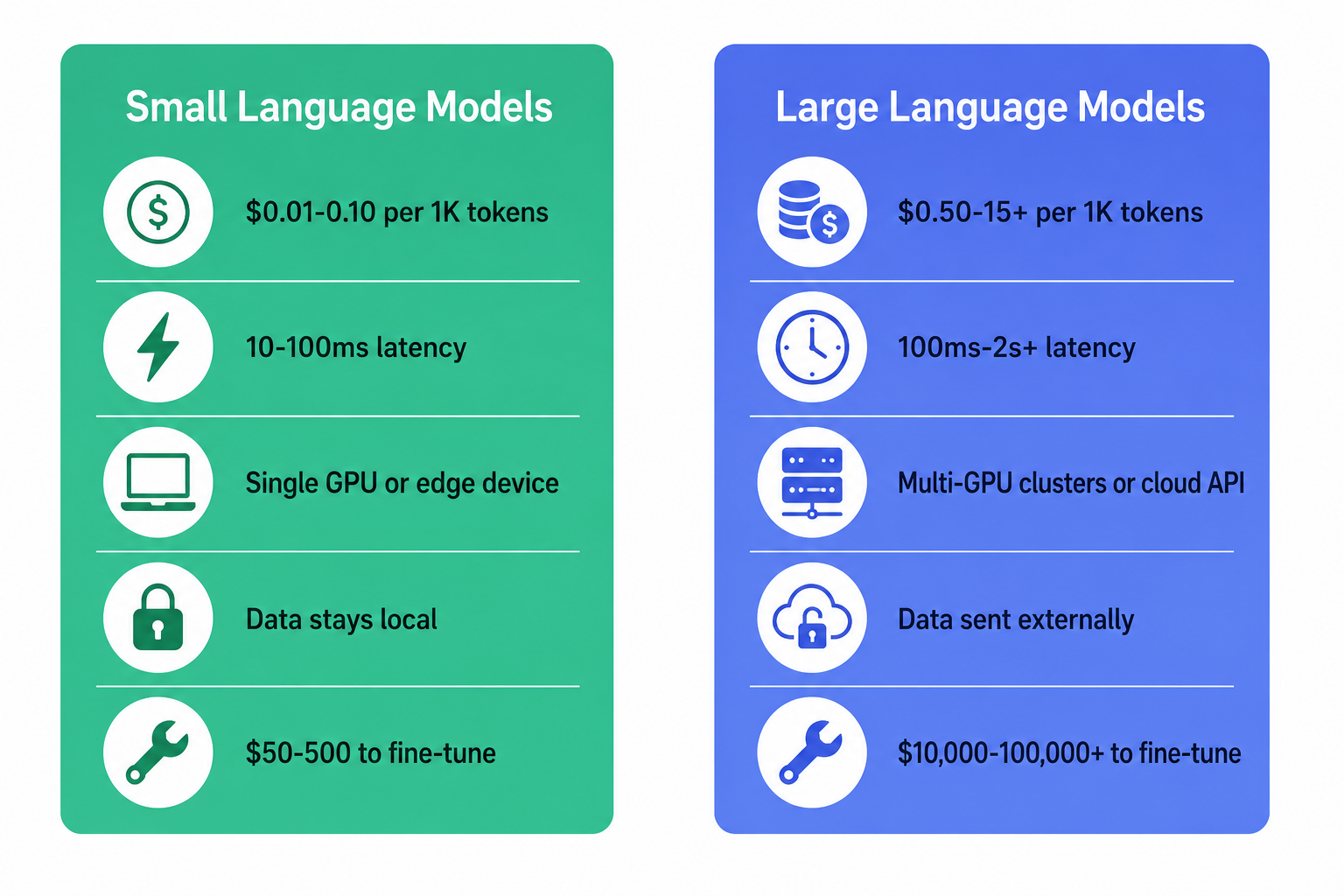
The cost and latency gap between these two model categories is wide enough to change architectural decisions entirely, and seeing the numbers side by side makes that clear fast.
What the Numbers Mean in Practice
A fine-tuned Phi-4 handling customer support classification runs around $200/month on dedicated hardware.
The same classification task routed through GPT-4 API calls lands closer to $8,000/month at comparable volume. That is a 40x cost difference on a task where both models hit the same accuracy threshold.
Latency tells a similar story. SLMs responding in under 50ms make real-time AI agents viable on edge devices, while LLM API round-trips introduce 500ms to 2 seconds of delay that kills the user experience for anything interactive.
And when it comes to customization, fine-tuning an SLM on your domain data for $300 opens up experimentation cycles that would cost $50,000+ with a comparable LLM, which means smaller teams can iterate on model performance without waiting for budget approval every time they want to try a new approach.
Why Are SLMs Becoming the Backbone for AI Agents?
Everything covered so far (cost, speed, privacy) converges the moment you start building AI agents, because agents magnify every advantage and every weakness of the model powering them.
What AI Agents Need from a Model
AI agents do not make one inference call and stop. They run in loops, autonomously making dozens or hundreds of calls per task as they classify, decide, act, and verify.
A customer support agent might pull the ticket, classify the issue, check the knowledge base, draft a response, and evaluate its own output before sending. That is five or six calls minimum for a single ticket.
Each of those calls needs to be fast, cheap, and private. When the model underneath is an LLM API charging per token with 500ms+ latency per call, those numbers compound into something painful very quickly.
Real Use Cases Where SLM-Powered Agents Win
The production deployments already happening tell the story clearly:
Customer support agents that classify, route, and draft responses on internal infrastructure without exposing ticket data to external APIs
Document processing agents in legal and finance summarizing and categorizing thousands of files daily within compliance boundaries
Code completion agents running locally in IDEs for teams working on proprietary codebases that cannot leave the building
On-device assistants in healthcare and manufacturing where connectivity is unreliable and latency tolerance is near zero
The Agent Cost Equation
Here is the math that changes minds. Say your agent makes 200 inference calls per task and runs 500 tasks per day. That is 100,000 calls daily.
At LLM API pricing ($0.01 per call on the low end) you are looking at $1,000/day or $30,000/month just in inference costs.
The same agent running on a fine-tuned SLM on a $3,000 GPU server costs roughly $200-400/month in compute.
Same output, same task completion rate, and the savings compound every single month the agent runs.
Where Do LLMs Still Win and When Should You Use Them?
SLMs have clear limits. Complex multi-step reasoning chains where the model needs to hold large context windows and draw non-obvious connections still belong to LLMs.
So does creative content generation requiring stylistic range and broad cultural knowledge, general-purpose chatbots that field unpredictable topics, and any task where accuracy on rare edge cases matters more than cost or speed.
Most mature teams run both and the split tends to look like this:
LLMs for exploration, prototyping, complex research, and tasks demanding breadth across domains
SLMs for production agents, high-volume workflows, and anything requiring speed, cost control, or data privacy
Knowing when to reach for which model is a judgment call most engineering teams are still developing.
ProgNXT's AI training builds that judgment systematically so your team stops defaulting to the biggest available model and starts deploying the right one for each task.
What Skills Does Your Team Need to Deploy SLMs Effectively?
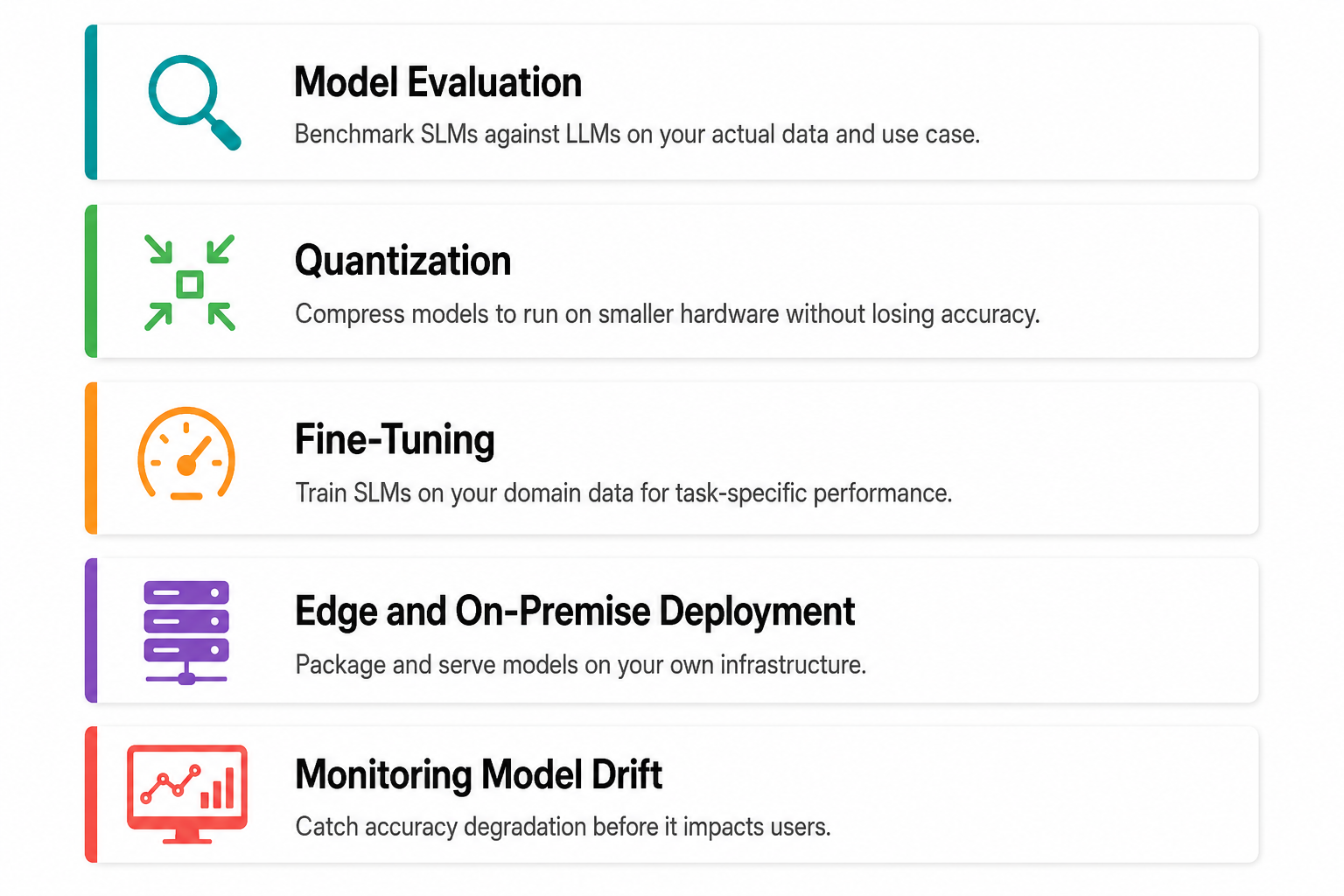
Most teams default to LLM APIs because that is what they learned first, what has the most documentation, and what every tutorial covers.
Deploying SLMs effectively requires a different skill set, and it is one that most engineering organizations have not built yet.
Model Evaluation
Knowing how to benchmark an SLM against an LLM on your specific task, with your actual data, using metrics that matter to your business. A model that scores well on public benchmarks can still underperform on your domain if you do not know how to test for it.
Quantization
Compressing a model to run on smaller hardware without destroying accuracy. The difference between a 7B model that needs a $10,000 GPU and the same model quantized to run on a $1,500 setup often comes down to whether someone on your team knows how to apply 4-bit or 8-bit quantization properly.
Fine-Tuning on Domain Data
Taking a general SLM and training it on your company's data so it performs at the level your use case demands. This is where SLMs pull ahead of LLMs on focused tasks, but only if someone on the team knows how to prepare datasets, manage training runs, and evaluate the results.
Edge and On-Premise Deployment
Getting a model off your laptop and into production infrastructure, whether that is an internal server, an edge device, or a fleet of on-premise machines. Packaging, serving, scaling, and monitoring in environments where you cannot rely on a cloud API to handle everything for you.
Monitoring Model Drift
Models degrade over time as the data they encounter in production shifts away from what they were trained on. Catching that drift before it impacts users requires monitoring pipelines that most teams have never had to build for their own models.
These are the skills that separate teams paying $30,000/month on LLM API calls from teams running the same workloads for a fraction of that.
ProgNXT's AI training programs cover all five, taking engineers from "we use GPT-4 for everything" to deploying the right model for each task with confidence.
Conclusion
SLMs are the right choice when your AI deployment needs to be fast, affordable, and private.
For AI agents, edge applications, compliance-sensitive workflows, and high-volume production tasks, a well-tuned small model consistently outperforms an expensive LLM API on the metrics that actually matter to your business.
The teams pulling ahead in 2026 are the ones that stopped defaulting to the biggest model and started right-sizing every deployment.
Your team is either choosing the right model for every task or overpaying for the wrong one.ProgNXT's AI training programs teach engineers to evaluate, fine-tune, and deploy SLMs so your AI stack runs leaner, faster, and fully within your control.